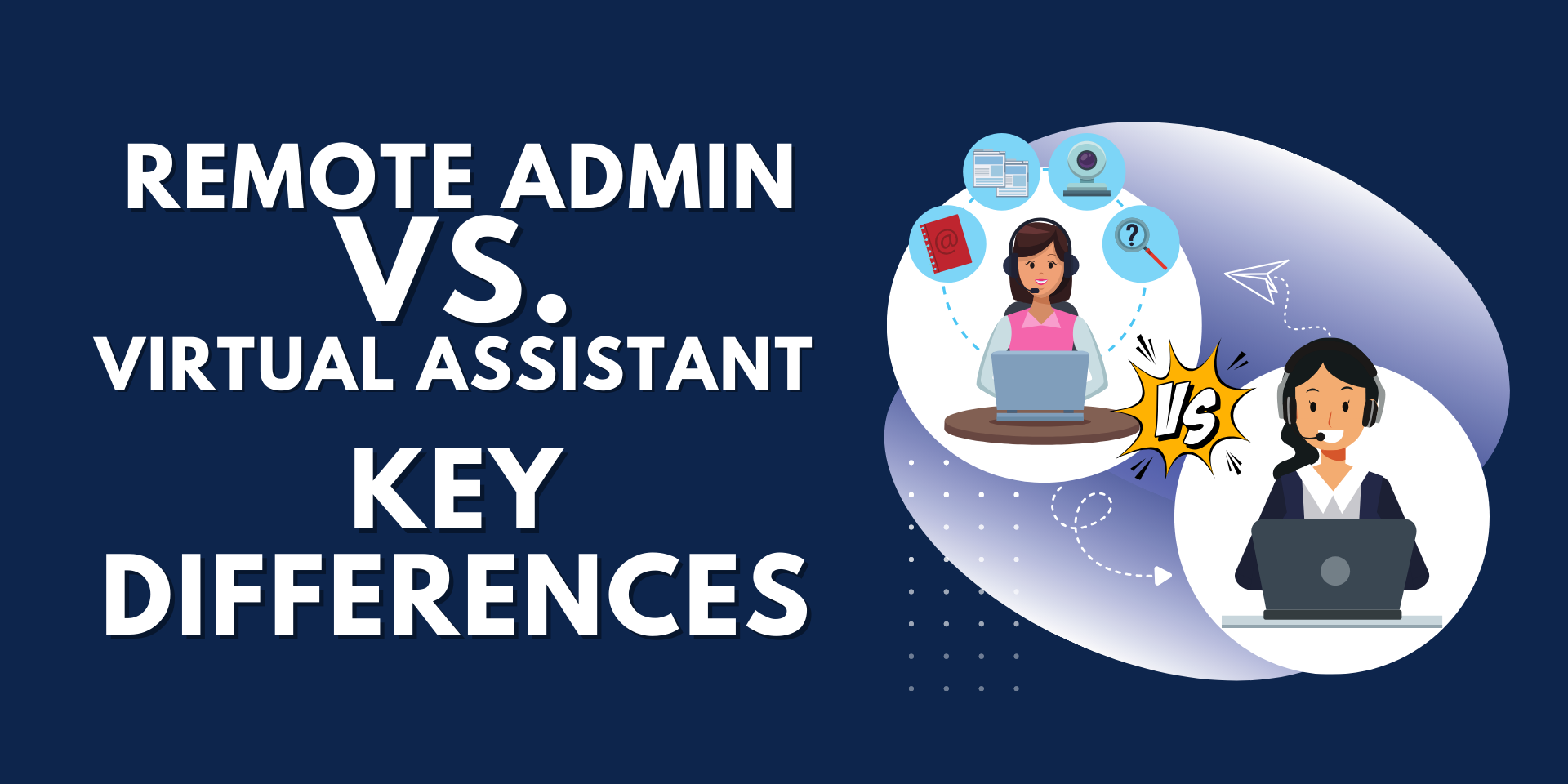
If you’ve ever looked into outsourcing help for your business, you’ve probably come across two common terms: remote administrative assistant (RAA) and virtual assistant (VA).
And if you’re anything like most business owners at this stage, you’re probably also dealing with a to-do list that’s longer than your day, tasks that keep getting pushed to tomorrow, and a growing sense that you can’t keep running everything yourself. You know you need help — you’re just not sure what kind. That’s exactly what this post is here to sort out.
At first glance, they sound like the same thing, and to be fair, they do share a lot of similarities. Both work remotely, both support your business, and both save you time. But there are some key differences, and knowing them can help you choose the right type of support for your business needs.
Let’s break it down in a simple, straightforward way.
What Is a Virtual Assistant (VA)?
A virtual assistant is a flexible professional who can take on a wide range of tasks, depending on their skills. Think of them as a “general helper” who adapts to what you need.
Examples of VA tasks include, but are not limited to:
- Social media posting and engagement
- Basic bookkeeping support
- Customer service responses
- Research projects
- Email and calendar management
Key trait: VAs often have diverse skill sets and may specialize in certain areas (like marketing, tech support, or content creation).
Best for: Business owners who need flexible, varied support on a project basis or part-time.
What Is a Remote Administrative Assistant (RAA)?
A remote administrative assistant is more like a dedicated, behind-the-scenes teammate focused on the operational and organizational side of your business. Their role is structured and consistent, often resembling that of an in-office administrative assistant, just virtual.
Examples of RAA tasks include:
- Managing calendars and appointments
- Coordinating meetings and travel
- Preparing reports and documents
- Handling emails and correspondence
- Maintaining organized systems (files, data, CRM)
Key trait: RAAs usually work more closely with you day-to-day, providing consistency, reliability, and long-term support.
Best for: Small businesses, startups, or solopreneurs who need steady, ongoing help to keep operations running smoothly.
The Main Differences at a Glance
Here’s a quick side-by-side comparison:
| Remote Admin Assistant | Virtual Assistant |
|---|---|
| Structured, consistent role | Flexible, varied tasks |
| Focused on admin and operations | Broader skill sets (can be admin, marketing, tech, etc.) |
| Works closely with you, often daily | May be project-based or part-time |
| Best for long-term business support | Best for short-term or specialized tasks |
What Changes When You Have the Right Support
It’s one thing to understand what each role does on paper. It’s another thing to picture what your workweek actually looks like once someone else is handling the tasks that are currently eating your time.
With an RAA managing your calendar, inbox, and daily operations, you stop starting every morning by triaging emails and figuring out where the day went. Your schedule runs predictably. Documents are ready when you need them. Follow-ups happen without you chasing them. The mental load of keeping everything organized quietly lifts—and you get to use that energy on the work that actually grows your business.
With a VA handling a specialized project—a product launch, a content push, a new system setup—you’re not scrambling to figure out something outside your expertise. You hand it off to someone who knows how to execute it, and it gets done.
In both cases, the shift is the same: you move from doing everything to directing everything. That’s not a small change. For a lot of business owners, it’s the difference between feeling stuck and actually moving forward.
Which One Do You Need?
It really depends on what stage your business is in and what kind of help you’re looking for:
- If your pain point is organization, time management, and daily admin tasks → an RAA is likely the best fit. They’ll bring order to the chaos and keep things moving smoothly every day.
- If you need specialized help for short-term projects (like launching a campaign or setting up a new system) → a VA might be the smarter option.
Some businesses even hire both—an RAA for consistent daily operations and a VA for project-based or niche needs.
Signs You’re Ready to Hire Remote Support
Not sure if the timing is right? Here are some honest indicators that you’ve reached the point where support stops being a luxury and starts being a practical necessity:
- You regularly end the workday with tasks you meant to get to but didn’t
- Administrative work is routinely crowding out time for clients, strategy, or growth
- You’ve missed follow-ups, appointments, or opportunities because nothing had a system behind it
- You feel like you’re the bottleneck in your own business
- You’ve thought about hiring help before but kept telling yourself it could wait
If two or more of those sound familiar, waiting isn’t saving you anything — it’s costing you time and opportunities every week. The right support doesn’t need to be a major commitment to start. It just needs to be the right fit for where your business is right now.
If you’re finding it hard to decide which type of support makes sense for your specific situation, that’s a conversation worth having with someone who places these professionals every day.
What About Hiring Both?
The idea of hiring both an RAA and a VA is worth exploring more than the brief mention it usually gets.
Think of it this way: an RAA handles the operational backbone of your business — the consistent, daily work that keeps everything running. A VA steps in for specific projects or skill sets your RAA doesn’t cover, like a social media push, a website update, or a research sprint.
This model works particularly well for growing businesses that have steady operational needs but also face periodic project demands. Rather than overloading one person or trying to find a single hire who does everything, you build a small, efficient support structure—each person doing what they do best.
The overhead is lower than you’d expect, especially when both roles are filled virtually, and the combined effect on your available time and mental bandwidth can be significant.
How to Find the Right Fit — Without the Guesswork
Understanding the difference between an RAA and a VA is step one. Step two is actually finding the right person — and that’s where a lot of business owners get stuck.
Posting a job, reviewing applications, interviewing candidates, checking references, and onboarding someone new is a process that takes time you probably don’t have. And if the hire isn’t the right fit, you’re back at the beginning.
This is where working with a virtual staffing agency changes the equation. Rather than running a search yourself, you work with a team that already has vetted, experienced professionals ready to step into either role. You describe your needs, your working style, and what you’re trying to accomplish—and the matching is done for you.
Our team specializes in exactly this. We work with small business owners, solopreneurs, and growing teams to find the right remote support — whether that’s an RAA, a VA, or a combination of both. We’ve placed professionals across a wide range of industries, and we understand that the right fit isn’t just about skills—it’s about how someone works with you.
Final Thoughts
While remote administrative assistants and virtual assistants share similarities, the distinction is important.
RAAs are like your dependable, day-to-day right hand — structured, reliable, and focused on keeping your operations organized.
VAs are your flexible support — jumping in where needed, often with specialized skills.
Neither option is “better” than the other; it’s about finding the right fit for your business.
Not Sure Which One You Need? Let’s talk.
If you’ve read through this and you’re still weighing your options—that’s completely normal. The right answer genuinely depends on your business, your workload, and what’s taking up your time right now.
The easiest next step isn’t committing to a hire. It’s having one straightforward conversation about where you are and what kind of support would actually move the needle for you.
We help business owners figure this out every day. There’s no pressure, no hard sell—just a clear, honest conversation about what makes sense for your situation.
Reach out today and let’s find the right fit for your business.

You Might Also Like
 Outsourcing Strategy
  Outsourcing Strategy
  Outsourcing Strategy