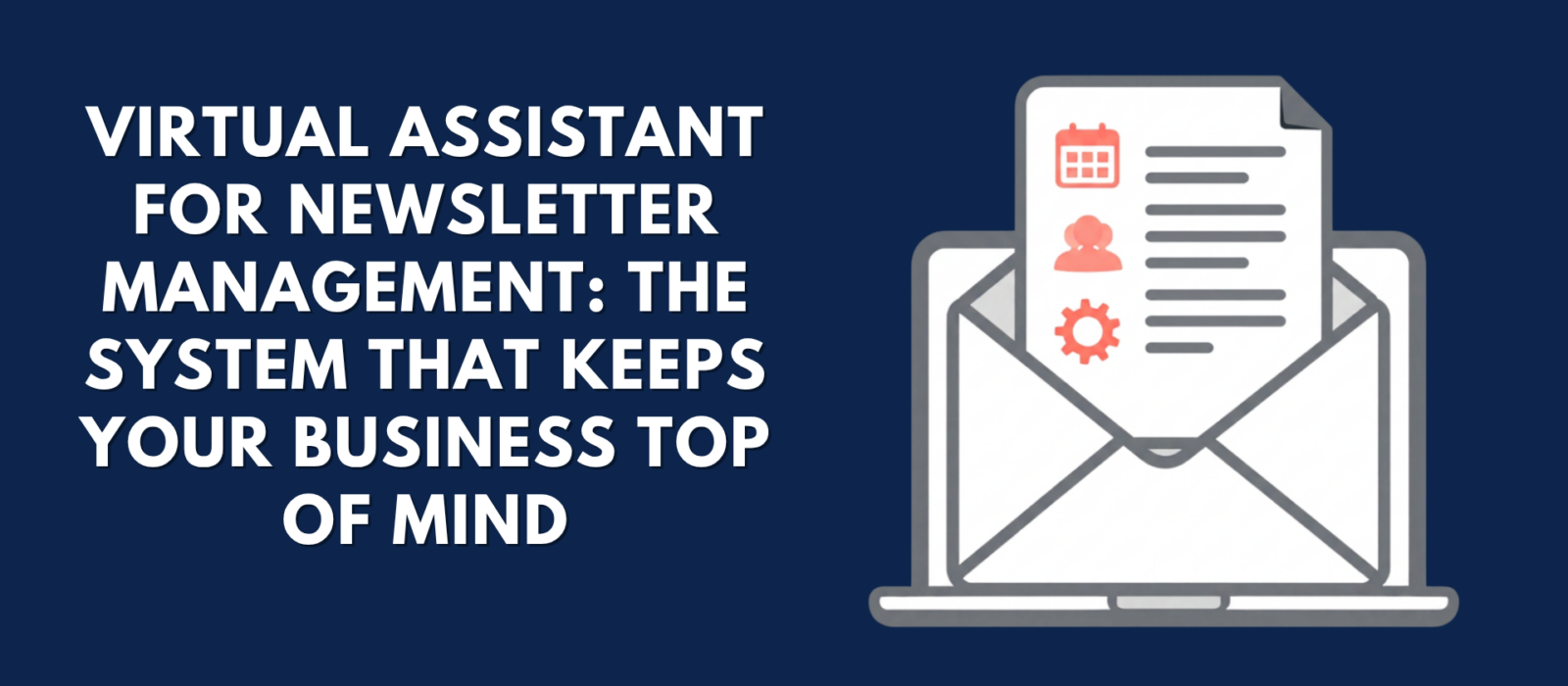
For small and mid-sized business owners, an email newsletter is one of the most cost-effective marketing channels available — but only when it actually goes out.
The problem isn’t the concept. Most business owners understand the value of staying in front of their audience week after week. The problem is execution. Between managing operations, handling clients, and keeping sales moving, the newsletter slides. One missed week becomes two. A “temporary pause” becomes three months of silence. And every week your list goes untouched is a week your competitors are showing up instead.
The solution isn’t working harder or carving out time you don’t have. It’s building a system—and putting a trained virtual assistant in charge of running it.
A virtual assistant for newsletter management handles everything from drafting and formatting to scheduling, segmentation, and performance reporting. The result: a newsletter that goes out consistently, builds audience trust, and drives measurable traffic back to your business — without requiring your attention every week.
Why Business Owners Struggle to Maintain a Newsletter — And What It’s Costing Them
The most common reason newsletters stop is not a lack of ideas. It’s a lack of operational infrastructure.
Most businesses launch a newsletter with strong intentions but no system behind it. When the owner is the only person responsible for writing, formatting, scheduling, and sending, the newsletter competes directly with everything else that generates revenue.
The result is predictable:
- Inconsistent send cadence that erodes subscriber trust over time
- Last-minute content that doesn’t reflect the brand’s quality standard
- No segmentation or list hygiene, leading to declining open rates and deliverability
- Zero tracking of what’s working, making improvement impossible
- Gradual list decay as subscribers disengage or unsubscribe from silence
According to Campaign Monitor, email marketing delivers an average ROI of $36 for every $1 spent — but that return depends entirely on consistency. A newsletter that goes out twice a quarter isn’t building a relationship; it’s wasting the list you worked hard to build.
A virtual assistant for newsletter management solves this at the operational level — not by writing for you, but by owning the system that makes writing and sending happen on schedule, every time.
📌 Key Takeaway: A newsletter virtual assistant doesn’t just save time — they transform your email list from a dormant asset into a consistent traffic and trust-building engine. The business case for delegation isn’t convenience; it’s compounding engagement over time.
What a Newsletter Virtual Assistant Actually Does
A newsletter VA is not simply a writer you hand off a topic to each week. In a well-structured system, they become the operational owner of your entire email marketing cadence — coordinating content, managing your platform, tracking performance, and keeping the operation running without pulling you into the details.
Here is what a trained newsletter VA handles:
1. Content Drafting and Formatting
Your VA takes your ideas — whether that’s a rough outline, bullet points, a voice note, or a link to a recent blog post — and turns them into a polished, on-brand newsletter ready to send.
They can:
- Draft structured newsletters from briefs, outlines, or raw source material
- Format content for platforms including Mailchimp, ConvertKit, ActiveCampaign, or Klaviyo
- Maintain a consistent tone, structure, and brand voice across every issue
- Apply your template, add images or graphics, and ensure the layout renders correctly on mobile and desktop
You retain editorial control. Your VA handles everything that turns an idea into a sent email.
2. Content Repurposing Into Email Format
One of the highest-leverage tasks a newsletter VA can perform is repurposing content your business is already producing. Most SMEs are generating useful material — blog posts, case studies, client updates, and social media content—but never converting it into email-ready formats.
Your VA can:
- Convert recent blog posts into newsletter summaries with links back to your site
- Repurpose client success stories into engagement-driving digest content
- Turn service announcements or promotions into cleanly formatted emails
- Build “roundup” editions from social posts, press mentions, or industry news
This approach dramatically reduces the content creation burden and ensures your newsletter consistently reinforces what your business is already doing.
3. Scheduling and Automation Management
Consistency drives email engagement more reliably than content quality alone. According to Mailchimp’s audience benchmarking data, businesses that send on a predictable schedule see significantly higher open rates than those with irregular cadences.
Your VA manages:
- Weekly or bi-weekly scheduling based on your target send day and time
- Automated welcome sequences for new subscribers
- Nurture flows for leads or prospects on your list
- Re-engagement campaigns for inactive subscribers
- Send time optimization based on audience performance data
This turns your newsletter from a one-off task into a running system—scheduled, monitored, and consistently delivered.
4. List Management and Segmentation
List quality matters as much as content quality. A newsletter sent to an unsegmented, unclean list will underperform no matter how good the writing is — and repeated poor performance signals will hurt your sender reputation over time.
A trained newsletter VA manages:
- Subscriber segmentation by lead source, purchase history, engagement tier, or opt-in category
- List cleaning — removing invalid addresses, suppressing chronic non-openers, and managing bounces
- Tagging and behavioral tracking so future campaigns are sent to the right segments
- CRM or platform sync to ensure your newsletter list stays aligned with your sales pipeline
Better list management translates directly to higher open rates, better deliverability, and more meaningful engagement from the subscribers most likely to convert.
5. Performance Tracking and Reporting
A newsletter without performance data is an activity, not a strategy.
Your VA monitors and reports on:
- Open rates and click-through rates by issue
- Unsubscribe trends and what content triggered them
- Top-performing subject lines and content formats
- Subscriber growth and list health metrics
- Traffic sent back to your website from each send
Rather than dumping raw data, a well-trained VA summarizes the insights that matter — what’s working, what to test, and what to cut — so your strategy improves continuously without requiring you to interpret dashboards.
6. Traffic Optimization — Turning Emails Into Business Outcomes
Every newsletter your VA manages is a direct traffic channel back to your business. Done well, a weekly send drives consistent, compounding traffic to your blog posts, service pages, landing pages, and offers.
Your VA optimizes for this by:
- Ensuring every email includes at least one clear, action-driving CTA
- Linking strategically to blog content, service pages, or lead capture forms
- Testing subject lines to improve open rates over time
- Analyzing which content formats generate the most clicks
- Building a historical content library so high-performing formats are repeated
Over six to twelve months, this compounds into a predictable, measurable traffic channel — one that costs far less than paid advertising and converts at a higher rate because the audience has already opted in.
Why SMEs and Growing Businesses Benefit Most
Large enterprises have dedicated marketing departments with email specialists on staff. That’s not the reality for most small and mid-sized businesses.
For SME owners, the marketing function typically falls to whoever has a spare hour — which means it doesn’t happen consistently, or it happens at the expense of revenue-generating work. That’s a structural problem, and it’s not solved by trying harder.
A virtual assistant for newsletter management solves it structurally. You get a dedicated person whose entire role is keeping the newsletter operation running—without the overhead of a full-time marketing hire and without the coordination burden of managing a freelance writer week to week.
The math is straightforward: a VA working part-time on newsletter management costs a fraction of a marketing salary, operates on your tools and your brand, and delivers far more consistent output than sporadic in-house effort ever will.
What a High-Performing Newsletter System Looks Like
When newsletter management is properly delegated to a trained VA, the workflow becomes systematic and predictable:
- You provide direction — an idea, a topic, a link to a recent blog post, or a brief voice note
- Your VA drafts and formats the newsletter, applying your brand template and tone guidelines
- Your VA schedules and sends on your established cadence, whether that’s weekly, bi-weekly, or monthly
- Your VA tracks performance and delivers a summary of open rates, clicks, and top content
- You review insights and refine strategy — adjusting content focus, offers, or cadence based on data
No missed weeks. No rushed content. No subscriber trust eroded by unexplained silence.
Just a consistent marketing engine that keeps your business visible and your list engaged.
The Most Expensive Mistake: Treating Newsletter Management as a Writing Task
Most business owners who struggle with newsletters misdiagnose the problem.
They say: “I don’t have time to write.”
The real issue is: “I don’t have a system for producing newsletters consistently.”
Writing is only one component of newsletter management — and in a well-structured VA relationship, it’s actually the smallest time investment you make. The more time-consuming tasks are the operational ones: drafting, formatting, scheduling, list hygiene, performance reporting, and platform management.
Once those operational components are owned by a VA, writing a brief for your newsletter — or even just approving a draft — takes fifteen minutes a week.
The business owners who maintain strong newsletters are not the ones with the most time. They’re the ones who have built the right system and delegated it correctly.
Ready to delegate your newsletter management?
Virtual Business Staffing matches you with a trained, dedicated VA who can take ownership of your entire newsletter operation — from first draft to final send. 📅 Book a Free Discovery Call Today →
Frequently Asked Questions: Virtual Assistant for Newsletter Management
What does a virtual assistant for newsletter management actually do? A newsletter VA handles the full operational layer of your email newsletter — drafting content from your briefs or outlines, formatting it in your email platform (Mailchimp, ConvertKit, ActiveCampaign, etc.), scheduling sends, managing your subscriber list, and reporting on performance metrics. They remove every step between your idea and a sent newsletter.
How do I brief a VA on my newsletter content each week? Most business owners use a simple process: a short bullet-point brief, a voice note, or a link to a recent blog post or content asset. Your VA takes that input and handles everything else — researching, drafting, formatting, and scheduling. You review and approve before it sends.
Can a VA manage my newsletter platform (Mailchimp, ConvertKit, or Klaviyo) directly? Yes. A trained newsletter VA works directly inside your email platform, building and scheduling emails, managing segments and lists, setting up automations, and pulling performance reports. Most platforms allow you to give a VA access without sharing your primary account credentials.
How much time does newsletter management actually take each week? For a weekly newsletter, a VA typically needs 3–6 hours per send—covering drafting, design formatting, list prep, scheduling, and post-send reporting. For a business owner managing this themselves, the same process often takes double that due to context-switching and platform unfamiliarity.
Is hiring a VA for newsletter management cost-effective for a small business? Yes—significantly more so than alternatives. A part-time newsletter VA typically costs far less than a freelance email copywriter on retainer or a marketing coordinator salary, while providing more consistent output and operational ownership. The ROI compounds as your list grows and engagement improves over time.
What’s the difference between a newsletter VA and an email marketing VA? A newsletter VA specializes in the recurring, relationship-building side of email—consistent weekly or bi-weekly sends that keep your audience engaged. An email marketing VA typically focuses on campaign strategy, automation flows, and promotional sequences. Many VAs handle both, but the newsletter function requires a different operational discipline: consistency over creativity.
Build the System. Delegate the Work. Show Up Every Week.
Your email list is one of the few marketing assets your business truly owns. Unlike social media followers or paid ad traffic, your subscriber list is yours — but only if you use it.
A virtual assistant for newsletter management gives your business the operational infrastructure to show up in your subscribers’ inboxes consistently, professionally, and strategically—week after week, without burning your time or your team’s capacity.
At Virtual Business Staffing, we match SMEs with trained, dedicated VAs who are ready to take full ownership of your newsletter from day one. No long learning curves. No missed weeks. Just a system that runs.
Book a free discovery call and find out how quickly we can get your newsletter running on autopilot.

You Might Also Like
 Business Growth
  Business Growth
  Business Growth