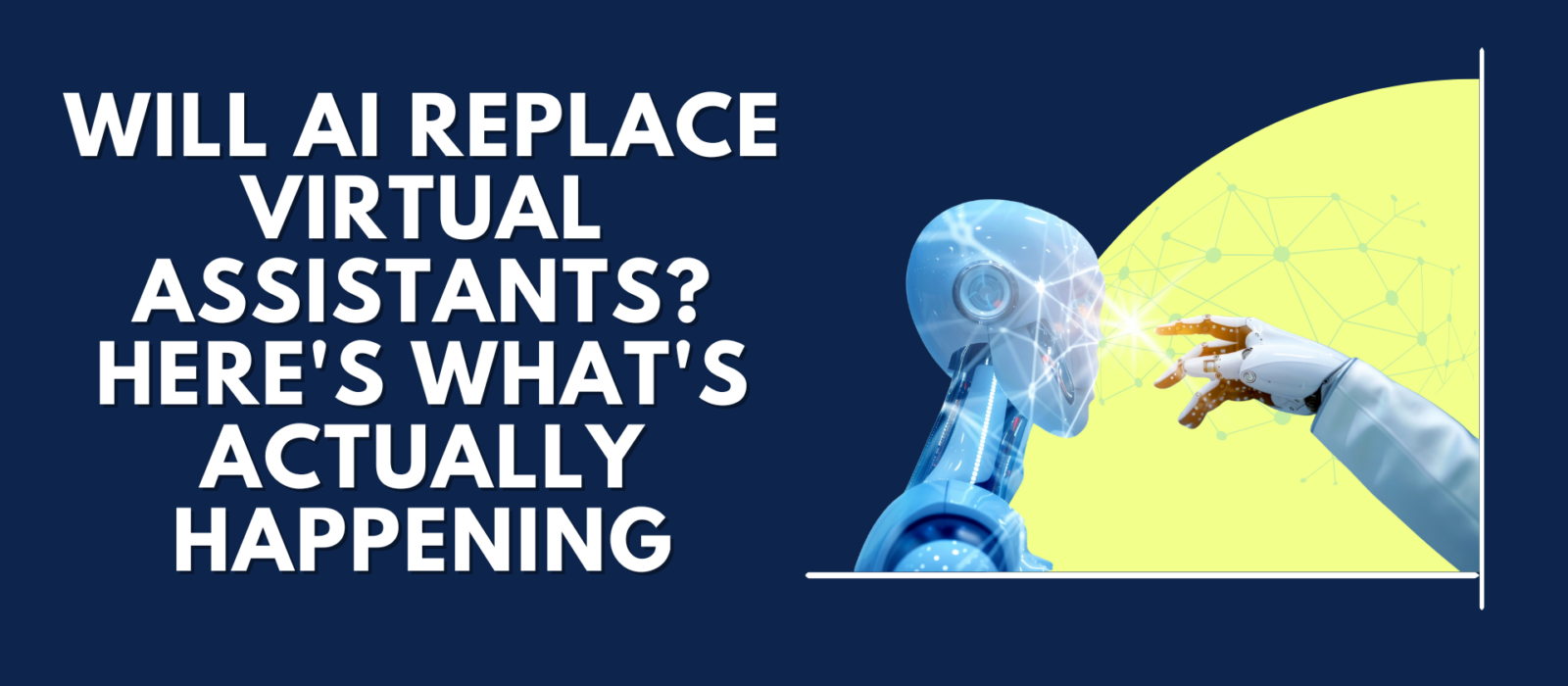
Every time a new wave of AI tools hits the market, the same question comes up: “Are virtual assistants about to be replaced?”
Short answer: no.
More accurate answer: the role is changing fast—and the assistants (and businesses) who adapt will pull ahead.
AI isn’t eliminating virtual assistants. It’s raising the standard of what a “good” VA looks like and shifting their value from basic task execution to higher-level support.
The Old VA Model Is Already Outdated
The traditional virtual assistant model was built on:
- Repetitive admin tasks
- Manual data entry
- Basic scheduling and inbox management
Those tasks are now the easiest for AI to handle.
If a VA’s value is purely “doing simple tasks,” then yes, AI will replace that version of the role.
But that’s not where the industry is heading.
What AI Actually Does Well — And Why That’s Good News for You
AI tools are exceptionally fast and consistent at:
- Drafting emails and responses
- Summarizing documents and meeting notes
- Generating content drafts (blogs, social captions, outlines)
- Automating repetitive workflows
- Extracting and organizing data from documents
This removes a huge amount of manual workload — and for a business owner, that’s actually great news.
Here’s why: when your VA is no longer spending three hours manually sorting through emails or formatting reports, they can spend those hours on the work that actually grows your business. AI handles the first pass. Your VA handles the judgment call.
But here’s the part most articles skip: AI still needs direction, context, and someone who understands your business. Without that layer, you end up with fast output that misses the mark.
That’s precisely where human VAs become more valuable — not less.
The Shift: From Task Executors to Operators
The most valuable virtual assistants today are no longer just “doers.” They’re operators.
Instead of “Write this email,” it becomes “Use AI to draft it, refine it based on brand voice, and send it at the right time.”
Instead of “Create social media posts,” it becomes “Use AI to generate ideas, then curate, edit, schedule, and track performance.”
AI does the first 60–70% of the work. A skilled VA completes the final 30% that actually makes it usable, accurate, and on-brand.
The businesses that understand this distinction are already operating at a different level than those still running the old model.
Where Human VAs Still Win — And Will Continue To
There are clear areas where AI alone consistently falls short. For business owners, these are the gaps that matter most.
1. Context and Judgment
AI doesn’t know your business. It doesn’t know that Client A needs a faster response than Client B, that a certain tone works better with your top referral partner, or that something “looks off” before a proposal goes out.
A well-trained VA does. They learn your patterns, your preferences, and your priorities — and they apply that knowledge without being asked.
2. Accountability
AI generates. It doesn’t own anything.
A VA is responsible for outcomes. They follow through, track tasks to completion, flag delays, and make sure things actually get done—not just started and auto-drafted.
When something falls through the cracks, a VA catches it. An AI tool moves on to the next prompt.
3. Relationship Management
Clients, partners, and vendors still want to interact with people — especially for anything sensitive, personalized, or relationship-dependent. High-stakes follow-ups, scheduling conversations, and handling a frustrated customer all benefit from a human voice and a human judgment call.
This is especially true in service-based businesses where trust is part of the product.
4. Workflow Integration and Cross-Platform Coordination
AI tools don’t run your business end-to-end. They handle isolated tasks.
A VA connects the dots—CRM updates, task tracking, tool switching, and cross-platform coordination—turning fragmented automation into a functioning system. Without that human layer, most businesses end up with scattered outputs and no real throughput.
What Smart Businesses Are Doing Right Now
The businesses pulling ahead aren’t choosing between AI or VAs. They’re combining both—deliberately.
Here’s what that model looks like in practice:
- VAs use AI tools to complete deliverables 2–3x faster
- Standard processes are enhanced with automation, cutting turnaround times
- Output quality increases because the VA reviews, edits, and applies judgment before anything reaches you
- Headcount stays lean because each team member produces significantly more
The result is leverage: more done, higher quality, at lower cost than expanding an in-house team.
If you’re ready to hire virtual staff who already work this way, the right agency makes that transition straightforward. At Virtual Business Staffing, we match business owners with trained, AI-proficient virtual assistants who are ready to operate at this level from day one.
What This Means for Hiring Virtual Staff
If you’re still screening virtual assistants with criteria like:
- “Can follow instructions”
- “Basic admin skills”
- “Available during business hours”
You’re hiring for the 2019 VA model. And you’ll get 2019 results.
What to look for now:
- Demonstrated comfort using AI tools (ChatGPT, Notion AI, Zapier, etc.)
- Ability to adapt workflows — not just execute tasks
- Strong written and verbal communication skills
- An ownership mindset — someone who tracks outcomes, not just hours
You don’t need more people. You need more capable ones. The right virtual staffing partner doesn’t just fill a seat—they help you identify exactly what kind of support will move the needle for your business, then match you with someone built for it.
The Real Risk Isn’t AI — It’s Standing Still
AI isn’t the threat. Stagnation is.
- If your workflows haven’t changed in the last year, you’re already losing efficiency
- If your team isn’t using AI at all, you’re paying more for slower output
- If you rely on AI without human oversight, you’ll run into quality and consistency issues
The advantage comes from combining both intelligently and building a team that knows how to do exactly that.
Practical Examples of AI + VA Working Together
Here’s what the hybrid model actually looks like in day-to-day business operations:
Inbox Management: AI drafts suggested responses based on email history. Your VA reviews, edits for tone and context, prioritizes by urgency, and sends—or escalates when judgment is required.
Content Creation: AI generates a first draft of blog posts, social captions, or email newsletters. Your VA refines the voice, checks for accuracy, formats for the platform, schedules, and monitors performance.
Customer Support: AI suggests replies to common inquiries. Your VA personalizes each response, handles escalations, and ensures the customer experience stays consistent with your brand standards.
Data Processing: AI extracts and structures data from documents or spreadsheets. Your VA verifies accuracy, flags anomalies, and enters finalized data into your systems—catching errors before they compound.
This hybrid model is faster and more reliable than either AI or a human working alone.
Where This Is Headed
The future of the VA industry isn’t fewer assistants—it’s more capable, tech-enabled assistants operating at a higher level with smaller teams.
Expect to see:
- Smaller teams producing more output than larger ones did five years ago
- Faster turnaround times as VA + AI workflows mature
- Higher expectations for quality, ownership, and specialization
- Increased demand for VAs with industry-specific expertise
The role doesn’t disappear. It levels up. And the businesses that get ahead of this shift will have a structural advantage that compounds over time.
The Bottom Line
AI changes how work gets done — not whether it gets done.
Virtual assistants who use AI become more productive, more valuable, and harder to replace. Businesses that pair skilled VAs with the right AI tools become more efficient and scalable without bloating headcount.
If you’re still thinking about this as a replacement question, you’re asking the wrong thing.
The better question is: “How do I build a virtual team that already operates this way?“
At Virtual Business Staffing, that’s exactly what we help you do. We source and place AI-proficient virtual assistants—trained, vetted, and ready to run the hybrid model from their first week.
Ready to build a smarter virtual team? Schedule a free consultation with Virtual Business Staffing today.

You Might Also Like
 Industry Insights
  Industry Insights
  Industry Insights