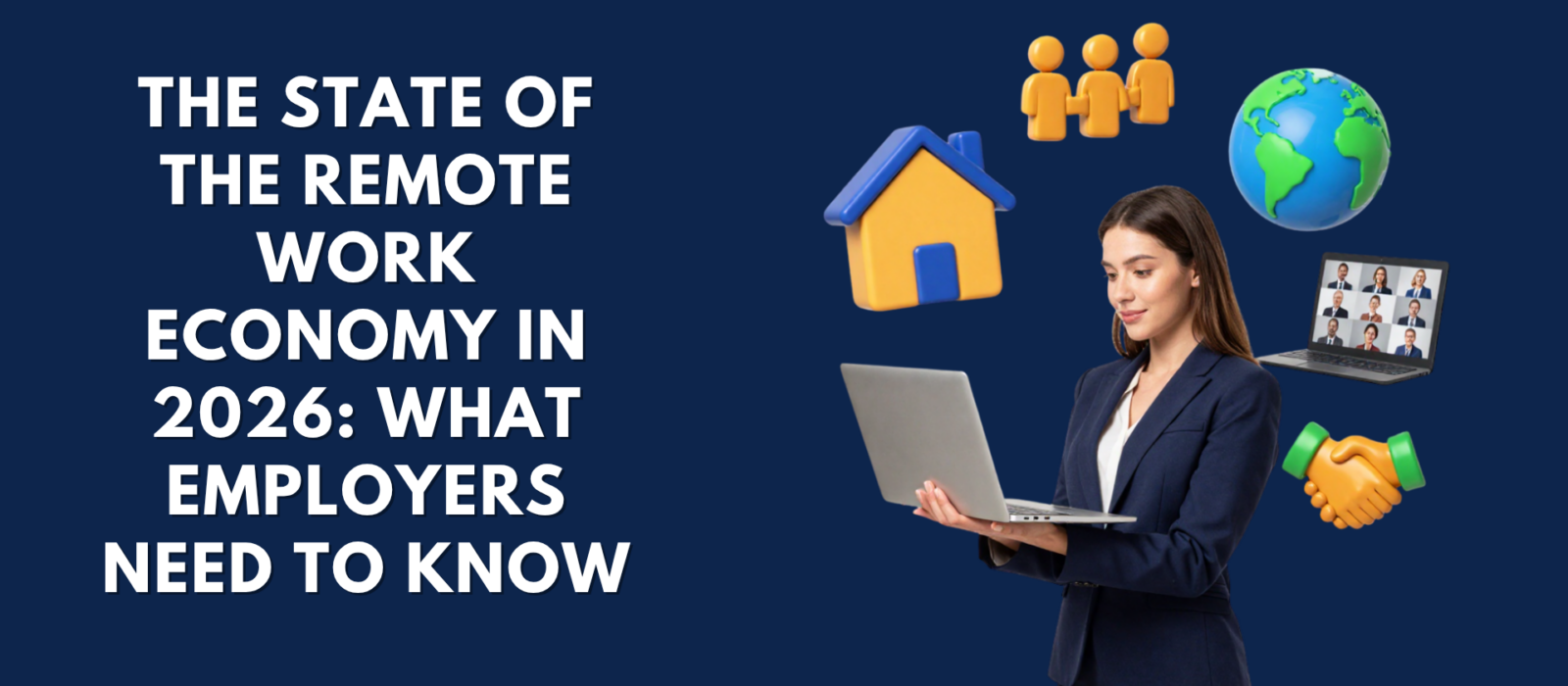
Remote work statistics for 2026 show that roughly 1 in 5 U.S. employees now works from home at least part of the time, and among employees whose jobs can be done remotely, hybrid arrangements — not fully remote or fully in-office — have become the dominant model. For employers, this isn’t a temporary post-pandemic hangover; it’s a structural shift in how hiring, retention, and staffing decisions get made. Below, we break down what the newest data actually says, and what it means for building a team that can compete in this market.
Remote work is no longer a temporary shift or a post-pandemic adjustment — it has become a permanent part of how businesses operate. In 2026, the remote work economy continues to evolve rapidly, shaped by advances in technology, changing workforce expectations, and increasing demand for flexible, cost-efficient hiring models. For employers, understanding this landscape is no longer optional. It directly impacts hiring strategy, productivity, retention, and overall business competitiveness.
Remote Work by the Numbers: What 2026 Data Actually Shows
The headlines about “the end of remote work” haven’t matched the data. According to the U.S. Bureau of Labor Statistics’ American Time Use Survey, 35% of employed people did some or all of their work at home on days they worked in 2025, while 70% did some or all of their work at their workplace. That share has held remarkably steady rather than collapsing back to pre-pandemic norms.
Zoom out to jobs that can be done remotely, and the picture sharpens further. Pew Research Center’s most recent survey of U.S. workers found that among employed adults who have a job that can be done from home, 75% are working remotely at least some of the time. Of that group, hybrid — not fully remote — is now the default: Pew’s data shows 43% of workers with remote-capable jobs now follow a hybrid schedule, up from about a third in 2022.
Robert Half’s 2026 Salary Guide analysis of job postings tells a similar story at the industry level, with wide variation by field. In fields like marketing and creative, technology, and legal, on-site work still makes up the majority of roles, but hybrid and fully remote arrangements now account for a meaningful share across nearly every professional category tracked.
What’s notable is how attached employees have become to this flexibility. Pew found that among workers who aren’t currently working from home all the time, 75% say their employer has put in-person requirements in place, up from 63% in early 2023 — and that pressure cuts both ways. In a separate survey, Pew reported that almost half of hybrid workers (46%) say they’d be unlikely to stay at their current job if they could no longer work from home. Employers who strip away flexibility aren’t just changing a policy; they’re introducing a retention risk.
Quick-Reference: Remote Work Adoption in 2026
| Metric | Figure | Source |
|---|---|---|
| Employed people who worked at home at least part of the day, 2025 | 35% | U.S. Bureau of Labor Statistics (ATUS) |
| Remote-capable workers who work remotely at least some of the time | 75% | Pew Research Center |
| Remote-capable workers on a hybrid schedule | 43% | Pew Research Center |
| Hybrid workers who’d likely leave if WFH were eliminated | 46% | Pew Research Center |
| Fields with the highest fully on-site share (marketing, legal, finance) | 70%+ on-site | Robert Half 2026 Salary Guide |
This table is a snapshot, not the full picture — the point isn’t any single number, it’s the trend line: remote and hybrid arrangements have stabilized well above pre-2020 levels, and businesses that ignore that reality are competing for talent with one hand tied behind their back.
Remote Work Has Become a Mainstream Hiring Model
In 2026, remote and hybrid roles are no longer niche offerings. They are standard expectations across many industries, especially in:
- Customer support and operations
- Administrative and executive assistance
- Digital marketing and content creation
- IT, software development, and data services
- Healthcare administration and virtual support roles
Businesses that fail to offer remote flexibility are increasingly finding it harder to attract top-tier talent — a dynamic borne out directly in the retention data above. If you’re weighing whether specific roles on your team are good candidates for this shift, our guide on 5 operational bottlenecks that disappear when you hire a virtual assistant walks through the most common friction points small teams run into first.
The Rise of Global Talent Pools
One of the most significant shifts in the remote work economy is access to a global workforce. Employers are no longer limited by geography. Companies can now hire skilled professionals from regions such as:
- Southeast Asia
- Eastern Europe
- Latin America
- Africa
This has created a more competitive and diverse talent market, where skills and performance matter more than location. As a result, businesses are optimizing costs while still maintaining high-quality output by hiring internationally distributed teams. We’ve written before about why the Philippines has remained a stronghold in outsourcing, and it’s a useful case study in how a single region can build deep, specialized talent pools around remote-friendly skill sets.
Building a genuinely diverse, distributed team isn’t just a cost play, either — it’s increasingly a deliberate workforce strategy. Our breakdown of DEI staffing strategies for remote teams covers how to build that intentionally rather than by accident.
Virtual Assistants and Remote Specialists Are in High Demand
A major driver of the 2026 remote economy is the growing reliance on virtual assistants and remote specialists. Companies are increasingly delegating tasks such as:
- CRM management
- Calendar and inbox management
- Lead generation and outreach
- Customer service support
- Data entry and reporting
- Social media and content scheduling
This transition enables internal teams to dedicate more time to high-impact work such as strategy, sales, and business development. If you’re trying to figure out exactly what to hand off first, our guide to CRM management tasks you can fully delegate is a good starting point, and our post on scaling to seven figures with virtual staff shows what that delegation looks like as a business grows.
One of the questions we hear most often from employers weighing this shift is simply: what does it cost? We’ve laid out current benchmarks in detail in Cost of a Virtual Assistant in 2026: What You’ll Actually Pay, and our in-house employee vs. virtual assistant cost comparison walks through the full loaded-cost math side by side.
Automation + Human Support = The New Standard
In 2026, automation tools and AI systems are widely used — but they are not replacing human workers entirely. Instead, they are reshaping roles. The most successful companies now use a hybrid model:
- Automation handles repetitive tasks
- Virtual assistants manage oversight, coordination, and personalization
- Internal teams focus on decision-making and growth strategy
This combination improves efficiency without sacrificing human judgment and adaptability. We go deeper on where AI genuinely changes VA work — and where it doesn’t — in Will AI Replace Virtual Assistants? Here’s What’s Actually Happening.
Employers Must Prioritize Systems, Not Just Hiring
Remote work success is no longer just about hiring talent — it’s about building systems that support distributed teams. Companies that perform well in 2026 typically invest in:
- Clear SOPs (Standard Operating Procedures)
- Well-structured onboarding processes
- CRM and project management systems
- Communication guidelines and accountability structures
- Performance tracking tools
Without these systems, remote teams can become fragmented and inefficient. This is a big enough topic that we wrote a full walkthrough on how to create SOPs for virtual assistants so your team can operate without you having to answer every question personally. Security is part of that systems conversation too — see our guide to cybersecurity in remote staffing for what distributed teams need to have in place before day one.
Employee Retention Has Become Just as Critical as Recruitment
With increased global mobility, employees have more opportunities than ever. This means retention is now a major challenge for employers. The data backs this up directly: Pew’s research found that almost half of hybrid workers (46%) — including 26% who say “very unlikely” — would not stay at their job if it stopped offering the flexibility to work from home.
Organizations are focusing on:
- Competitive compensation structures
- Skill development and training opportunities
- Clear growth paths and role progression
- Strong communication and leadership support
- Healthy work-life balance policies
Employers who fail to invest in retention risk high turnover and operational instability — a risk that compounds when the roles in question are hard to backfill quickly.
The Cost Advantage Remains Strong, but It’s Now Approached More Strategically
While remote work is still cost-effective, the conversation has shifted in 2026. It is no longer just about saving money — it is about strategic allocation of resources. Businesses now evaluate remote hiring based on:
- Productivity per role
- Time saved through delegation
- Scalability of operations
- Quality of output versus cost
As a result, companies have become more selective, prioritizing value over cost alone. This is exactly why we built out a full in-house employee vs. virtual assistant cost comparison for 2026 — the fully loaded numbers (benefits, office space, equipment, turnover cost) tell a very different story than a simple salary-to-salary comparison.
What This Means If You’re Hiring in 2026
Pulling the statistics above into a practical framework, here’s how the shift breaks down for employers making staffing decisions this year:
| If you’re seeing… | The data suggests… | Practical next step |
|---|---|---|
| Difficulty attracting candidates for on-site-only roles | You’re competing against the 75% of remote-capable workers who already work remotely at least part-time | Evaluate which roles are genuinely location-dependent vs. habit-dependent |
| Rising turnover after a return-to-office mandate | You’re in the ~46% of workers who’d leave over lost flexibility | Consider a hybrid or fully remote alternative before losing institutional knowledge |
| Growing task backlog with no headcount budget | Delegation, not more full-time hires, may be the lower-cost fix | Map out which tasks are strategy vs. execution, and delegate the latter |
| Interest in expanding talent access | Global and nearshore hiring pools are deeper and more specialized than ever | Start with one or two clearly defined, delegable roles rather than a full team build-out |
Frequently Asked Questions
What percentage of employees work remotely in 2026?
According to the U.S. Bureau of Labor Statistics, 35% of employed people did some or all of their work at home on the days they worked in 2025. Among workers whose jobs can specifically be done remotely, Pew Research Center found that figure jumps to 75% who work remotely at least some of the time.
Is hybrid work more common than fully remote work in 2026?
Yes, for most remote-capable roles. Pew Research Center reports that 43% of workers with remote-capable jobs now follow a hybrid schedule — splitting time between home and the office — rather than working fully from home or fully on-site.
Will return-to-office mandates reverse the remote work trend?
The data doesn’t point that way so far. Even as more employers introduce in-person requirements, Pew found that 46% of hybrid workers say they’d be unlikely to stay in their job if remote flexibility were eliminated entirely. That retention risk is pushing many employers toward hybrid compromises rather than full reversals.
Why are businesses hiring virtual assistants instead of full-time in-house staff?
Virtual assistants let businesses delegate specific, well-defined tasks (like CRM management, scheduling, or customer support) without the fully loaded cost of a full-time in-house hire — benefits, office space, and equipment included. See our full cost comparison for a side-by-side breakdown.
What industries have adopted remote work fastest?
Adoption varies significantly by field. Robert Half’s 2026 job posting data shows technology, legal, and marketing roles skew more heavily toward on-site work than administrative and customer support roles do, though hybrid arrangements have grown across nearly every category tracked.
How do I know which tasks are worth delegating to a virtual assistant?
Start with recurring, well-defined tasks that don’t require your direct judgment call every time — inbox and calendar management, CRM upkeep, data entry, and social scheduling are common starting points. Our guide on operational bottlenecks that disappear with a virtual assistant breaks this down role by role.
Closing Insight
In 2026, the remote work economy is well-developed, highly competitive, and increasingly structured. It is no longer defined by temporary flexibility but by long-term strategic workforce planning. For employers, achieving success is no longer just about hiring remote talent — it also involves developing strong systems, tapping into global talent, and effectively combining technology with human expertise.
Businesses that adapt to this shift will not only reduce operational costs but also gain a significant advantage in speed, efficiency, and scalability.
Not sure where to start? Book a free consultation and we’ll help you map out which roles on your team are the best fit for remote delegation — and match you with a hand-selected, top-tier virtual professional to fill them.
Ready to build a team that fits how work actually happens in 2026? Get in touch with Virtual Business Staffing to talk through your specific hiring needs — no obligation, just a conversation about what’s actually slowing your team down.

You Might Also Like
 Industry Insights
  Industry Insights
  Industry Insights